GRA AUSTRALIA
Golden Retriever Atlas Evidence-led guidance for Australian homes
ReferenceAustralia
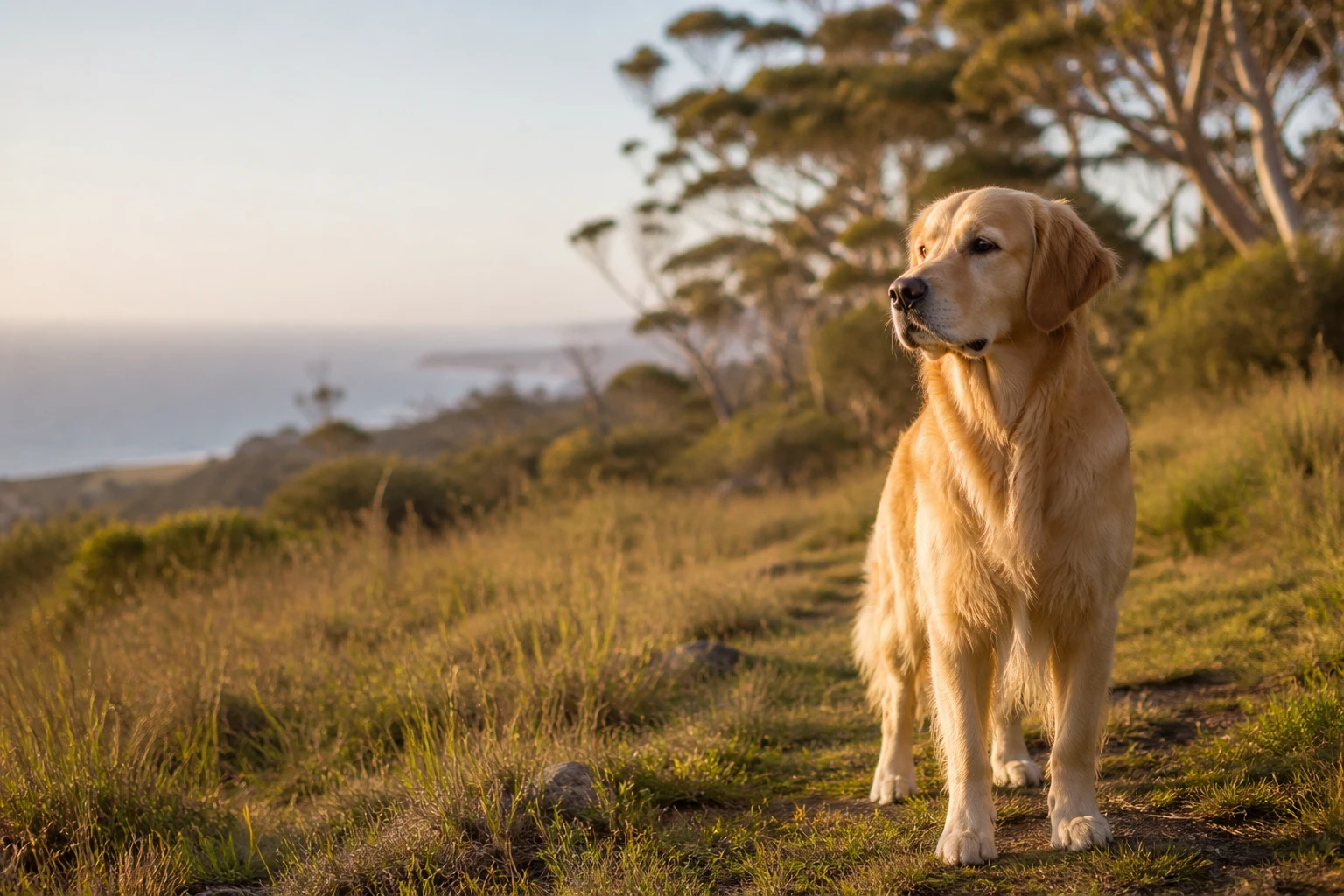
Golden Retriever standing on a coastal path above an Australian beach at sunrise

Golden Retriever knowledge ยท Australian context

A clear map for life with a Golden Retriever

Use standards for orientation, evidence for important claims and the individual dog for everyday decisions. Explore care, health, behaviour and responsible acquisition without reducing a living dog to a breed label.

Illustrative image: a Golden Retriever on an Australian coastal path at sunrise.

How to use this atlas

Standard for context, individual for care

The Golden Retriever is recognised in Australia as a gundog with a written ideal for structure, movement, coat and temperament. The Dogs Australia Golden Retriever standard is the correct starting point when a claim concerns the Australian conformation ideal. It describes a balanced, active dog with working ability and gives defined height, coat and colour language. It does not function as a diagnosis, personality test or household compatibility score.

Within the breed, individuals differ in size, coat volume, sociability, sensitivity, persistence, retrieving interest, response to novelty and ease of settling. Age and life stage change what a dog can comfortably do. Learning history, health, pain, sleep, environment and relationships influence behaviour. A puppy's current friendliness cannot promise adult temperament, while an adult's quiet behaviour in one setting may not transfer immediately to another. Good decisions combine breed context with observation over time.

This distinction protects both reader and dog. A standard can explain why a water-resistant double coat is characteristic; a veterinarian assesses abnormal hair loss or inflamed skin. Breed heritage can explain why carrying objects and searching games may be engaging; it cannot prove that every Golden will retrieve safely or enjoy every dog sport. The atlas uses this pattern throughout: identify the type of claim, follow it to the responsible authority, then return to the needs of the individual.

Daily responsibilities

Build the week before choosing the dog

A Golden Retriever needs more than occasional exercise. The household must make room for social contact, training, coat care, rest, veterinary care and flexible plans across a dog's life.

Movement with recovery

Provide daily opportunities to walk, sniff, explore and play, adjusted for age, fitness, weather and health. Repetition is not the same as suitability: sustained running, jumping and intense retrieving ask different things of a growing puppy, a conditioned adult and a senior dog. Watch gait, enthusiasm and recovery rather than chasing a universal exercise quota.

Company with calm independence

Plan for shared time and for gradual, comfortable periods apart. Teach settling in a safe resting place while people move around the home. A camera can show whether alone time involves sleep or escalating distress. Sudden inability to settle, destruction associated with panic or persistent vocalisation warrants a welfare-focused conversation with a veterinarian or qualified behaviour professional.

Training in ordinary moments

Practise recall, loose-lead walking, greetings, releasing found objects and calm handling in short sessions. Reward choices you want repeated and arrange the environment so success is possible. The AVSAB position statements support reward-based training and provide guidance on puppy socialisation and humane methods.

Rest, food and household systems

Budget for appropriate food, preventive care, equipment, professional support and changes in mobility later in life. Protect undisturbed sleep and use predictable routines without making the dog dependent on one rigid schedule. The WSAVA nutrition resources help owners discuss diet choice and body condition with their veterinary team.

Health and screening

Use records to improve information, not to make promises

Health screening and individual veterinary care answer different questions. Screening of prospective parents can document findings relevant to inherited risk; it does not certify a future puppy as disease-free. A database entry records a test and result under a particular protocol. It cannot describe every condition, environmental influence or event that may affect a dog throughout life.

Golden Retriever health programmes commonly emphasise hips, elbows, eyes and cardiac assessment. The Golden Retriever Club of America screening overview explains the purpose and limitations of those examinations, while the OFA CHIC programme explains an especially important database rule: a CHIC number means required results were completed and made public, not that every result was normal. These United States resources are useful for understanding records and imported pedigrees; they do not replace current Australian requirements, local schemes or veterinary interpretation.

When researching a puppy, request the registered identity of each parent, the issuing body, examination date, result and a link or number that can be checked independently. Ask what was screened, what remains untested and what is known about close relatives. For an adult from rescue or private rehoming, gather veterinary history, medication details and any available diagnostic records, then arrange care with your own veterinarian. Missing history creates uncertainty; it does not justify guessing.

Preventive care belongs to the individual. The Australian Veterinary Association vaccination policy supports appropriate immunisation while placing frequency decisions with the veterinarian, based on health, age, disease, environmental risk and vaccine duration. The AAHA canine life-stage framework similarly brings behaviour, nutrition, parasites, dental care, vaccination and breed considerations into an individual plan.

Online guidance can help you prepare questions and recognise a boundary. New breathing difficulty, collapse, repeated unproductive retching, severe pain, major trauma, seizures, inability to stand or rapidly worsening illness requires urgent veterinary direction. Persistent or concerning changes also deserve examination; this page cannot assess urgency for a particular dog.
Coat, skin and handling

Grooming is a care routine, not a cosmetic event

The characteristic coat combines an outer layer with a dense, water-resistant undercoat and feathering. Build a recurring routine that reaches behind the ears, under the collar, through the furnishings, around the tail and between the legs. After swimming or a wet outing, check for tangles, trapped debris and grass seeds, then dry the coat and ear flaps comfortably. Seasonal shedding changes the time required.

The RSPCA Australia grooming guide treats grooming as a welfare opportunity: remove loose hair, prevent mats and check ears, skin, feet and nails. Introduce brushing, foot handling and equipment gradually with food, pauses and choice. A professional groomer can help with technique and workload, while a veterinarian is the correct professional for pain, inflamed skin, discharge, persistent odour, wounds or a sudden coat change.

Do not assume a short trim removes maintenance. Skin, nails, ears and regrowth still require attention. Severe matting can hide inflammation and make removal painful; professional clipping may be safer than pulling or cutting near skin. Comfort and movement take priority over preserving a particular outline.

Education and enrichment

Teach skills while meeting behavioural needs

Effective education is cooperative, observable and adaptable. Start with management: prevent access to unsafe objects, use gates or leads where needed and offer legal items to carry and chew. Reward check-ins, calm greetings, returning when called and trading an object for something worthwhile. Practise at an easy level before adding distance, distraction or duration. Progress is better measured by the dog's response than by a fixed timetable.

Socialisation means carefully building useful experiences, not maximising the number of greetings. Pair new people, surfaces, sounds, travel, grooming and veterinary-style handling with safety and the option to move away. Avoid forcing contact. Coordinate a puppy's exposure plan with a veterinarian so developmental needs and local infectious-disease risk are considered together. Continue confidence-building into adolescence and adulthood.

Enrichment can include sniffing routes, searching for scattered food, retrieving by consent, swimming where conditions are safe, simple scent games and learning household tasks. Rotate activities and preserve rest. Repeated frantic ball chasing is not the only expression of a retriever heritage, and more intensity is not automatically better. If behaviour changes abruptly, becomes dangerous or is accompanied by pain, appetite change, sleep disruption or confusion, begin with a veterinary assessment.

Finding a puppy or adult

Choose a process before choosing a face

Begin with compatibility. Write down who provides morning and evening care, how long the dog may be alone, where safe exercise happens, how children and resident animals will be supervised, and who handles grooming, training and transport. Price the recurring costs as well as the first week. Consider whether an adult's more observable behaviour and coat may suit the household better than the developmental demands of a puppy.

Australia has state and territory rules affecting registration, identification, sale and animal welfare. Verify requirements with the relevant government and local council rather than assuming one national procedure. For adoption, the RSPCA Australia adoption guide encourages careful matching and provides a pathway to dogs needing homes. Ask a rescue or rehomer about known health, behaviour, handling, time alone, interactions and return support, while recognising where history is incomplete.

When evaluating a breeder, use the RSPCA Australia responsible-breeder checklist as a starting point. Confirm identity, inspect the rearing environment directly or through credible live evidence, meet the mother where possible, verify parent health records and read the agreement before payment. Ask how puppies are raised, how placement decisions are made and what lifelong return arrangements exist. Registration or club membership is one record, not a substitute for the whole evaluation.

Pause when there is pressure to pay immediately, identities or parent records cannot be checked, the environment is hidden, health is guaranteed, questions are discouraged or the seller will not discuss return arrangements. Keep copies of advertisements, messages, database results, veterinary documents and agreements. A responsible decision may be to wait, adopt, choose an adult or decide that another breed better fits the home.

Frequently asked questions

Practical starting answers

Does the breed standard predict what every Golden Retriever will be like?

No. A breed standard describes an ideal for conformation and function; it is not a forecast of an individual dog's health, behaviour, energy or suitability for a household. Age, inherited traits, development, learning, health and environment all matter. Evaluate the dog in front of you as well as the breed-level context.

How much exercise does a Golden Retriever need?

There is no responsible universal minute target. Plan daily opportunities for movement, sniffing, play, training and rest, then adjust for age, fitness, weather, health and recovery. Puppies, conditioned adults and senior dogs need different plans. Ask a veterinarian about exercise when pain, disease, rapid fatigue or mobility change is present.

How often should a Golden Retriever be groomed?

Use a recurring routine rather than waiting for mats. Check the coat, ears, feet and skin after swimming, wet walks and contact with grass seeds, and brush often enough to keep the double coat comfortable and tangle-free. Coat density, season and lifestyle change the workload. Painful skin, inflamed ears or severe matting need professional assessment.

Which health records matter when researching a Golden Retriever puppy?

Ask for the registered identities of both parents and independently verifiable results relevant to Golden Retrievers, commonly including hip, elbow, eye and cardiac assessment. Confirm the current protocol with the applicable Australian registry, breed body and your veterinarian. A completed screening programme improves information; it cannot guarantee a puppy's future health.

Is a puppy always a better choice than an adult Golden Retriever?

No. A puppy offers an early developmental relationship but requires intensive supervision, socialisation, education and flexible daily care. An adult may have a more observable size, coat, behaviour and activity pattern. Ethical rescue, rehoming and carefully documented puppy sources can all be responsible pathways when matched to the household.

Are Golden Retrievers automatically suitable for children and other animals?

No breed label removes the need for assessment and supervision. Consider the individual dog's history, comfort, arousal, handling tolerance and recovery from stress, alongside the children's ages and the needs of resident animals. Use gradual introductions, protected rest areas and active adult supervision, and seek qualified help when interactions are tense or unsafe.