Event identity
Match affiliate, date, location, show type, judge allocation and order of judging. Note a catalogue version or amendment rather than replacing the earlier file.
Catalogue · certificate · confirmation
A document-by-document method for testing a conformation claim without mistaking a post, photograph or private points total for an official record.
“Champion”, “Best in Show winner” or “titled young” bundles several facts together. Separate the claim into an event, date, organising affiliate, show type, judge, registered dog, class, exact award and—only where relevant—points credited. A title is a later administrative conclusion built from qualifying records; it should not be reverse-engineered from publicity.
Evidence also has levels. A schedule shows what was authorised and advertised. An entry receipt shows that an entry was accepted. A catalogue identifies the dogs entered. A marked catalogue, official results return and award certificate record outcomes. The relevant state or territory member body validates a title application and updates the registration record. Each source answers a different question.
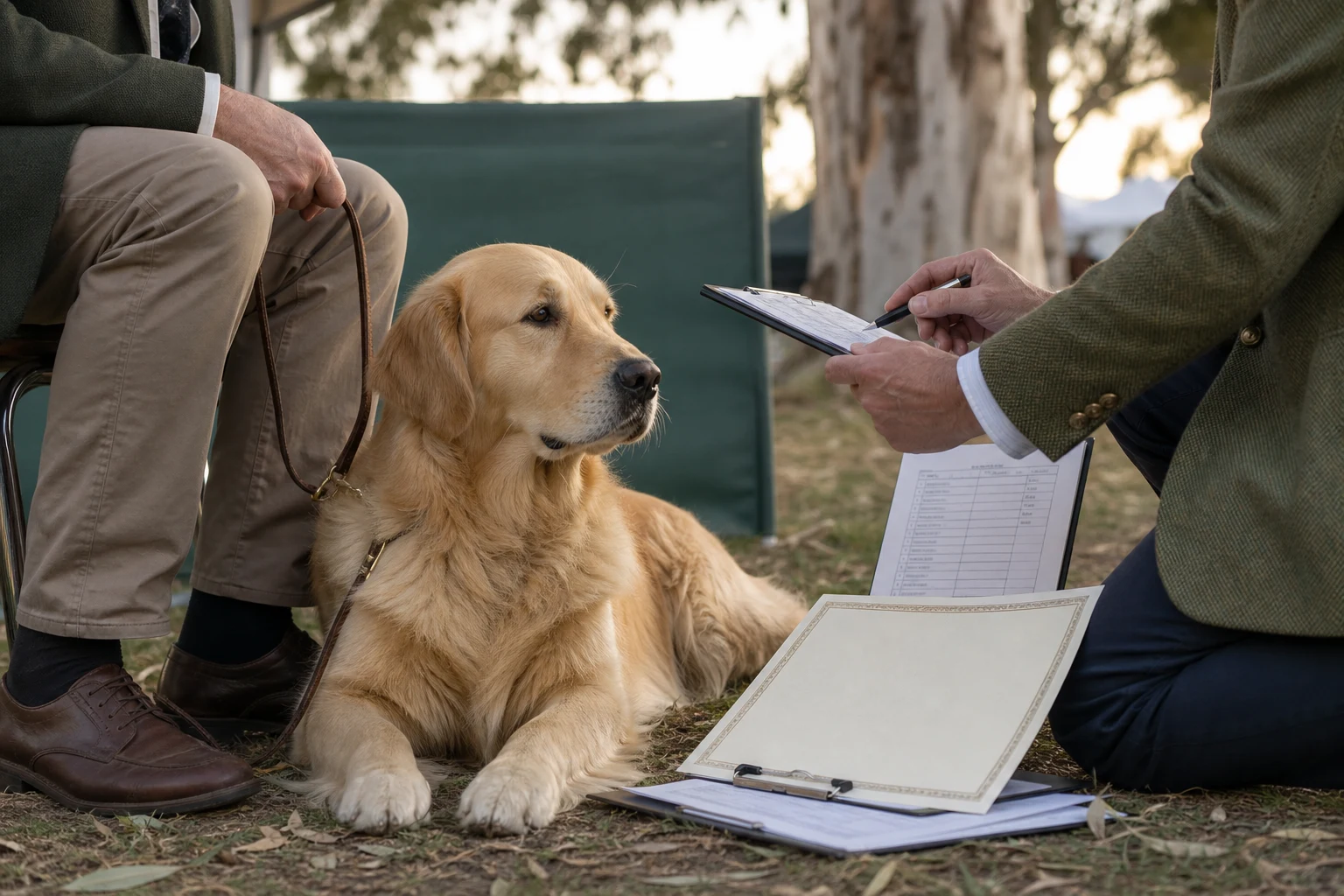
Step one
Locate the official schedule or member-body event listing. Record the affiliate, event name, venue, date, show type, advertised judge and classes. The Dogs NSW showing guide explains the role of schedules and their core event details. Retain later notices about a changed judge, date, venue or cancellation; the first advertisement may not describe the event that actually ran.
Show type matters. The Dogs NSW guide to show types distinguishes Championship Shows, where qualifying certificates and points may be awarded, from Open Shows and Parades, where championship points are not awarded. A class win at an Open Show is a valid result, but it cannot be silently relabelled as a Championship Show Challenge.
Then save the rules effective on the event date. The current Dogs Australia Conformation Show Regulations, Part 5 took effect on 1 January 2026 and defines show types, classes, catalogues, judging order, certificates, points and titles. The regulations index is the better starting point for a current audit, because later amendments may replace a saved PDF.
Step two
The catalogue connects the event to the exhibit, but an unmarked catalogue is not proof of a result.
Match affiliate, date, location, show type, judge allocation and order of judging. Note a catalogue version or amendment rather than replacing the earlier file.
Compare the exact registered name, sex, date of birth, sire and dam with the pedigree. Use the registration number from the entry or certificate where the catalogue omits it.
Record the entered class and exhibit number. Confirm the dog was age- and status-eligible under the rules then in force; similar class names are not interchangeable.
Find the marked catalogue or official results return. “Entered” does not mean “present”, and a catalogue position is not a placing.
Part 5 specifies minimum catalogue information and requires the affiliate to retain a marked catalogue and event records, then forward a marked catalogue to the state member body within its timeframe. The Dogs NSW club-forms page publishes official show results and representative-report forms, showing the reporting layer that sits behind a public announcement.
Step three
A class first, Challenge, Best of Breed, group award and Best in Show occupy different stages of judging. Record the precise wording. Do not convert “class in group” to “group winner”, or a Reserve Challenge to a Challenge. The Dogs Australia conformation overview follows the progression from breed classes through Challenge, Best of Breed, group and general specials.
For a Challenge or Best of Breed certificate, compare the registered name and number with the pedigree, then check the affiliate, event date, sex, award, judge and points or exhibit-count fields used on that form. Preserve front and back, annotations and any accompanying result sheet. A ribbon or trophy may commemorate an award, but it does not carry the same identity and validation fields.
Check names literally. A call name, abbreviated affix or photograph cannot identify the registered dog. The Dogs Australia pedigree guidance explains why the registration certificate is the official identity and ancestry record. Our separate pedigree and health-record verification guide provides a fuller identity crosswalk.
Published results
A club post, entry-provider page or photograph can help locate a result, but ask who published it, when, from which source and whether it is marked provisional. Save the URL, access date and full context. Screenshots lose update history and can omit the event heading, class, sex, judge or correction notice. Search-engine snippets and reposts are discovery tools, not primary records.
Prefer the organising affiliate’s marked catalogue or results return, followed by the member body’s record. For an international CACIB claim, use the FCI results portal: it distinguishes confirmed results from proposals still being processed. That distinction is a useful general lesson—an announced award and a later homologated or registered record are not always the same stage.
Older records may survive only in gazettes, catalogues or archives. Describe what the surviving source actually says and identify gaps. A photograph of a dog beside a ribbon cannot safely supply a date, judge, event or official award. Several consistent secondary sources can strengthen a lead, but they do not manufacture a missing primary document.
Step four
A spreadsheet can reveal duplicate dates, inconsistent points or missing certificates. Enter one row per result: event, date, state, show type, judge, class, exact award, certificate identifier, eligible entry count where relevant, points claimed, rule version and source. Never fill a gap by extrapolating from a photograph or later total.
Apply the rule in force on each award date and keep prerequisites separate from accumulated points. The detailed thresholds belong in our Champion and Grand Champion guide; long-record and rule-change questions belong in the Supreme Champion evidence guide. Here, the critical boundary is authority: private arithmetic can test a claim, but it cannot award or backdate a title.
Application details differ by jurisdiction. The Dogs NSW awards page requires a title application and original pedigree; the Dogs Victoria title FAQ lists the application, results and registration record it expects; Dogs Queensland title forms and Dogs SA title applications provide their own current routes. Use the member body responsible for the registered owner and check its live instructions.
The strongest evidence of the completed administrative step is confirmation from the competent member body and the updated registration record showing the title. A title in an advertisement before that step should be described as pending, not awarded.
Corrections and preservation
When sources conflict, preserve both. List the discrepancy—name, number, class, award, date, judge or points—and send a concise query to the organising affiliate or member body through its official contact route. Include document identifiers, not unrelated personal information. Do not edit a scan, recreate a certificate or ask a social-media audience to decide.
The Dogs Victoria title FAQ explicitly provides a correction route for a title printed incorrectly. Other bodies have their own processes: use the live forms directories, including Dogs Victoria forms and the national Dogs Australia forms and procedures. Keep the original, correction request, response, amended certificate and date together so the audit explains the change.
For each completed check, save a read-only copy, source URL, access date and a short conclusion: verified, contradicted, pending or not verifiable from surviving records. Revisit pending items rather than turning uncertainty into accusation. This method protects both accuracy and fairness.
A narrow kind of evidence
A confirmed result shows what an approved judge awarded under a particular event’s rules. It does not diagnose orthopaedic, cardiac or eye health, establish genetic status, describe behaviour across daily life or predict offspring. Even repeated wins remain show evidence, not a general certificate of quality.
Welfare also outranks record completion. Illness, injury, distress or unsafe heat is a reason to withdraw or seek care, not a missing data point to overcome. The Dogs Australia Judges’ Code of Practice supplies conduct context, while our judging guide explains the ring examination’s limits. No title audit should encourage concealing a fault, manipulating a record or presenting an uncomfortable dog.
Frequently asked questions
No. An unmarked catalogue shows the event and entered exhibits; it does not prove attendance, judging or an award. Look for the marked catalogue or official results sheet, the relevant Challenge or Best of Breed certificate, and later member-body confirmation. Match every source to the same dog, event, date and class.
Compare the registered name and registration number with the pedigree, then check the event, affiliate, date, award, sex, judge and points or exhibit count fields used by that form. Confirm that the event was a Championship Show and keep the complete certificate, not a crop that removes qualification or signature fields.
Your calculation is a useful error check, not title confirmation. Apply the rules effective on each award date, exclude ineligible or duplicated results and retain supporting certificates. The relevant Dogs Australia state or territory member body validates the application and updates the registration record; do not present a private spreadsheet as an awarded title.
Preserve both versions and record when each was accessed. Compare dog identity, class, judge, event and award against the marked catalogue or official results return. Ask the organising affiliate or relevant member body to resolve the discrepancy through its official channel, and describe the claim as unresolved until a correction or confirmation is issued.
No. It may help locate an event, but it can be cropped, edited, reposted without context or published before validation. Use it as a lead to the schedule, catalogue, official results, certificate and updated registration record. Archive the original URL and date rather than treating a detached image as a primary record.
No. A confirmed title records that defined show requirements were met under the applicable rules. It is not a veterinary clearance, genetic result, whole-life temperament assessment or welfare guarantee. Evaluate health records, behaviour, daily function and any reproductive decision through separate evidence and appropriately qualified professionals.
Continue in context
Award verification is useful only when its scope remains clear.
Understand points, certificates and confirmation.
02Audit high-level claims across rule changes.
03See what a ring result can and cannot establish.
04Match registration and health-record trails.
05Return to daily life, health and individual variation.
06Question conclusions drawn from photographs.