Observation · consistency · limits
Photographing Golden Retriever movement, coat and condition responsibly
A useful image is a dated observation made under known conditions. It can support comparison and a veterinary conversation; it cannot diagnose health, explain lameness, certify structure, predict temperament or establish breeding quality.
Begin with a question
Decide what the record is meant to show
“Take a photo” is too vague for reliable follow-up. Decide whether you are documenting comfortable movement, a visible coat or skin change, general outline, or a change in everyday function. Write the question down and record one category at a time. A side-on movement sequence cannot answer the same questions as a close coat image, and neither substitutes for hands-on assessment.
The American Animal Hospital Association’s guidance on chronic pain assessment notes that owner photos and videos can help when an activity is intermittent or cannot be reproduced in the clinic. Their value comes from adding home context to clinical assessment—not from turning the owner or camera into a diagnostic tool.
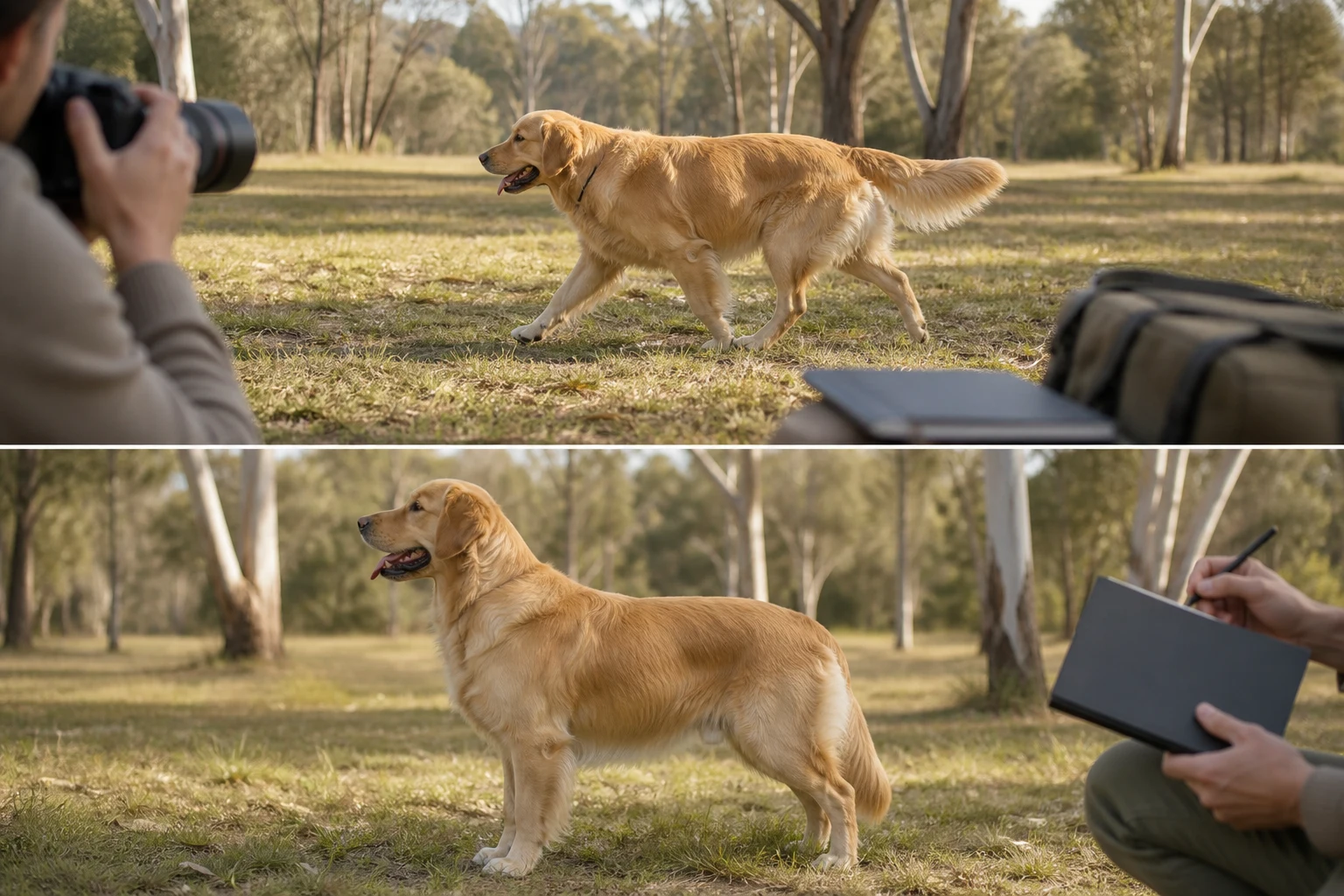
Build a repeatable setup
Use a level, firm, non-slip surface that is comfortable underfoot and not dangerously hot. Keep the background uncluttered and the lighting broad and even. Harsh side light deepens shadows; backlight can erase coat edges; wet or freshly fluffed coat changes the outline. If comparison matters, return at a similar time of day and record the coat state and weather rather than trying to “correct” the picture later.
Choose one camera or phone, orientation and lens setting. Mark a safe camera position and repeat the distance. Keep the camera approximately level with the area of interest rather than tilting sharply down from standing height; a close wide-angle view can enlarge the nearest body parts. Include the whole dog and feet in conformation or movement frames. An ordinary reference marker in the scene can support scale, but never place an object where the dog may trip.
For a standing set, take left side, right side, front and rear views while the dog stands naturally. Do not pull limbs into position or hold the head and tail to manufacture an outline. The RSPCA’s reward-based training guidance supports using outcomes the dog values, without fear, pain or intimidation. A brief session, familiar helper and voluntary pause usually produce a more honest record than restraint.
Record a sequence, not a pose
Movement needs time, surface and context
A single stride freezes one phase of gait and can make normal asymmetry look important—or miss a repeated change. Record a short continuous video at the dog’s comfortable walk and, if the dog willingly offers it, a natural trot. Use a straight, level path, film from a stationary position perpendicular to travel, keep the entire dog in frame and repeat in both directions. A front and rear approach may add context. Avoid zooming, panning erratically or asking for repeated high-speed passes.
Note the surface, direction, pace, lead handling and activity immediately before filming. A tight lead, turn, distraction, fatigue, long coat, slippery grass or uneven ground can alter the picture. If the concern happens on stairs, rising, entering a car or after rest, describe that pattern to the veterinarian and ask what can be recorded safely. Do not rehearse an activity that appears painful merely to obtain a better clip.
The Dogs Australia breed standard describes an ideal of powerful, level, straight and true movement. That language helps explain conformation, but comparing a home video with the standard is not a lameness examination. The Australian conformation process combines observation in stance and motion with hands-on examination, and even that ring procedure is not veterinary diagnosis.
Let welfare end the session. Freezing, repeated turning away, tucked posture, struggling, marked panting unrelated to ordinary conditions, vocalising or inability to move comfortably are reasons to stop. Read the whole body and situation, as advised in the RSPCA canine communication guide; one facial expression or tail position does not reveal temperament.
Coat, skin and body outline
Make change visible without over-reading it
For coat comparison, use dry coat in a similar grooming state, neutral surroundings and colour-accurate light. Take an orientation view that shows where the area sits on the body, then a closer unfiltered view. If safe, place a clean ruler beside—not over—the area. Record whether the coat was wet, brushed, clipped or parted. Keep colour balance and exposure natural; save any annotated or cropped version as a derivative while preserving the original.
Photographs can show surface appearance, distribution and change over time. They cannot determine why hair is thinning, whether a lump is benign, or what lies beneath the coat. Do not squeeze, scrape or repeatedly handle a sore area for a photograph. New or spreading lesions, swelling, discharge, a pain response or substantial coat change deserve veterinary advice.
Body outline also needs restraint in interpretation. The World Small Animal Veterinary Association nutrition guidance treats body condition and muscle condition as distinct clinical assessments. Its current body-condition chart includes viewing and palpating ribs, waist and abdominal tuck; coat, stance and lens perspective can conceal them. Serial images may prompt a useful question, but a veterinary team should interpret weight, hands-on condition, muscle and health together.
Preserve the evidence trail
Keep originals, metadata and a short observation log
Retain the original file and give each session a stable private identifier. Record capture date, local time and time zone; check the device clock. Add the dog identifier, camera or phone, lens setting if available, approximate distance, light, surface, pace, recent activity, coat state and the behaviour or functional change that prompted recording. State who filmed it and whether a clip was trimmed, slowed, cropped or colour-adjusted.
The IPTC Photo Metadata Standard provides widely used fields for creation details, descriptions, people, locations, identifiers and rights. Embedded metadata is convenient, not infallible: device clocks can be wrong, some platforms remove fields and editing software can rewrite them. A simple separate log and the untouched original make the trail easier to audit.
Compare like with like at purposeful intervals, not constantly. Review the same views side by side and add ordinary function: willingness to rise, duration of usual walks, appetite, sleep, play and any change in behaviour. AAHA’s senior-care pain guidance likewise treats home videos as information for the veterinarian, alongside history and examination.
Consent and proportionate sharing
A useful record does not have to become public
Ask permission before recording or publishing identifiable handlers, children, neighbours or bystanders, and obtain the responsible adult’s agreement for a child. Frame tightly enough to exclude faces, house numbers, vehicle plates, computer screens and veterinary paperwork. The Australian eSafety Commissioner’s online safety checklist recommends turning off geotagging or metadata when posting because platforms do not always remove location and device data.
Keep the full private original when location or capture data matter to your record, but export a separate public copy with precise GPS and unrelated personal information removed. Name files with a neutral code rather than an owner’s address, phone number or medical detail. Share only what the veterinarian or other intended recipient needs, through a channel they accept. Consent to take an image is not automatically consent to publish, reuse or attach names.
Veterinary boundary
Know when to put the camera down
Arrange veterinary advice for a new or persistent uneven gait, stiffness, reluctance to rise or exercise, swelling, a skin or coat change, pain response, reduced appetite or changed everyday activity. The AAHA overview of possible pain signs shows why behaviour and function belong in the history. Images may clarify timing, but they should not be used to select treatment, medication or exercise.
Collapse, breathing difficulty, major trauma, uncontrolled bleeding, inability to stand or walk, seizures or severe distress require urgent veterinary care. The American Veterinary Medical Association first-aid guide states that first aid should be followed by immediate veterinary care. In Australian heat, suspected heatstroke is also an emergency: follow the RSPCA heatstroke guidance and contact a veterinarian immediately. Recording another take must never delay care.
Images also cannot certify conformation, stable temperament or breeding merit. A flattering stance does not replace a skilled physical examination; a quiet second does not represent behaviour across environments; a clear-looking coat says nothing about inherited risk. For those separate evidence trails, use the Atlas breed and health guide, Australian judging guide and explanation of conformation titles.
Frequently asked questions
Six practical limits for a visual record
Can a photograph or video diagnose lameness?
No. An image can record an uneven step, reluctance or a change noticed at home, but it cannot identify the cause or rule out pain. Gait varies with speed, surface, handling, fatigue and the moment captured. Share the original sequence and context with a veterinarian, who may need history, physical examination and other tests.
Which angles make a useful comparison set?
For standing images, record both sides plus front and rear views, with the whole dog visible and the camera at a repeatable height and distance. For movement, a stationary side view of a comfortable walk and trot in both directions is usually more informative than one dramatic frame. A veterinarian may request different views for a specific concern.
How should I photograph coat or skin changes?
Use even light, accurate colour, the same coat state where practical, a wider orientation image and an unfiltered close view. Record the date and body location; include a clean scale beside, not on, the area if safe. Do not irritate a painful site or delay veterinary advice for a spreading lesion, swelling, discharge or marked discomfort.
Should I force a show pose or faster gait for a clearer image?
No. A naturally comfortable stance and pace are more honest and protect welfare. Use a calm helper, a familiar cue and reward-based handling. Stop if the dog freezes, repeatedly turns away, struggles, appears painful, becomes distressed or cannot move freely. A forced pose can distort the very feature you are trying to record.
What metadata should I keep, and what should I share?
Keep the original file, capture date and time, dog identifier, camera or lens setting where available, distance, light, surface, pace, recent activity and relevant observations. Check that the device clock is correct. For public copies, remove precise location and unrelated personal details; share the minimum necessary through a secure channel agreed with the recipient.
When does an observation need veterinary attention?
Arrange veterinary advice for a new or persistent uneven gait, stiffness, reluctance, swelling, skin or coat change, pain response, reduced appetite or altered activity. Seek urgent veterinary care for collapse, breathing difficulty, major trauma, uncontrolled bleeding, inability to stand or walk, seizures, severe distress or suspected heatstroke. Do not keep filming while urgent care is needed.
Continue through the Atlas
Place images beside the right evidence
A photograph becomes more useful when its purpose, limits and related records are clear.
Breed guide
Daily life, coat care, activity, health and individual variation.
02Finding a dog
Evaluate identity, records, environment and responsible sourcing.
03Conformation judging
Understand the standard, hands-on examination and movement.
04Reading titles
Separate a title from health, temperament and breeding decisions.