GRA AUSTRALIA
Golden Retriever Atlas Evidence-led guidance for Australian homes
ReferenceAustralia

Standard · movement · limits

How Golden Retrievers are judged in Australia

A conformation result records a comparison made under particular rules on one day. It is useful evidence, but it is not a health certificate, temperament diagnosis or breeding guarantee.

The standard describes an ideal, not an average dog

Australian conformation judging starts with the Dogs Australia Golden Retriever breed standard. Dogs Australia describes a standard as a guideline to the ideal characteristics, temperament and appearance of a breed, with fitness for function and soundness in mind. The task is comparative: the judge considers each eligible exhibit against that written ideal, then against the other dogs competing for the same award.

The standard asks for a symmetrical, balanced, active and powerful dog with level movement, a kindly and confident disposition, and structure suited to traditional retrieving work. Judges weigh faults according to degree and effect on health, welfare and work. One isolated feature does not automatically outweigh the whole dog.

Australia’s published text identifies the Royal Kennel Club standard as its origin and notes FCI Standard 111. The FCI breed record helps explain international nomenclature. At an Australian event, however, the schedule and current Dogs Australia and state member-body rules determine what applies; an overseas rule should not be imported merely because wording looks familiar.

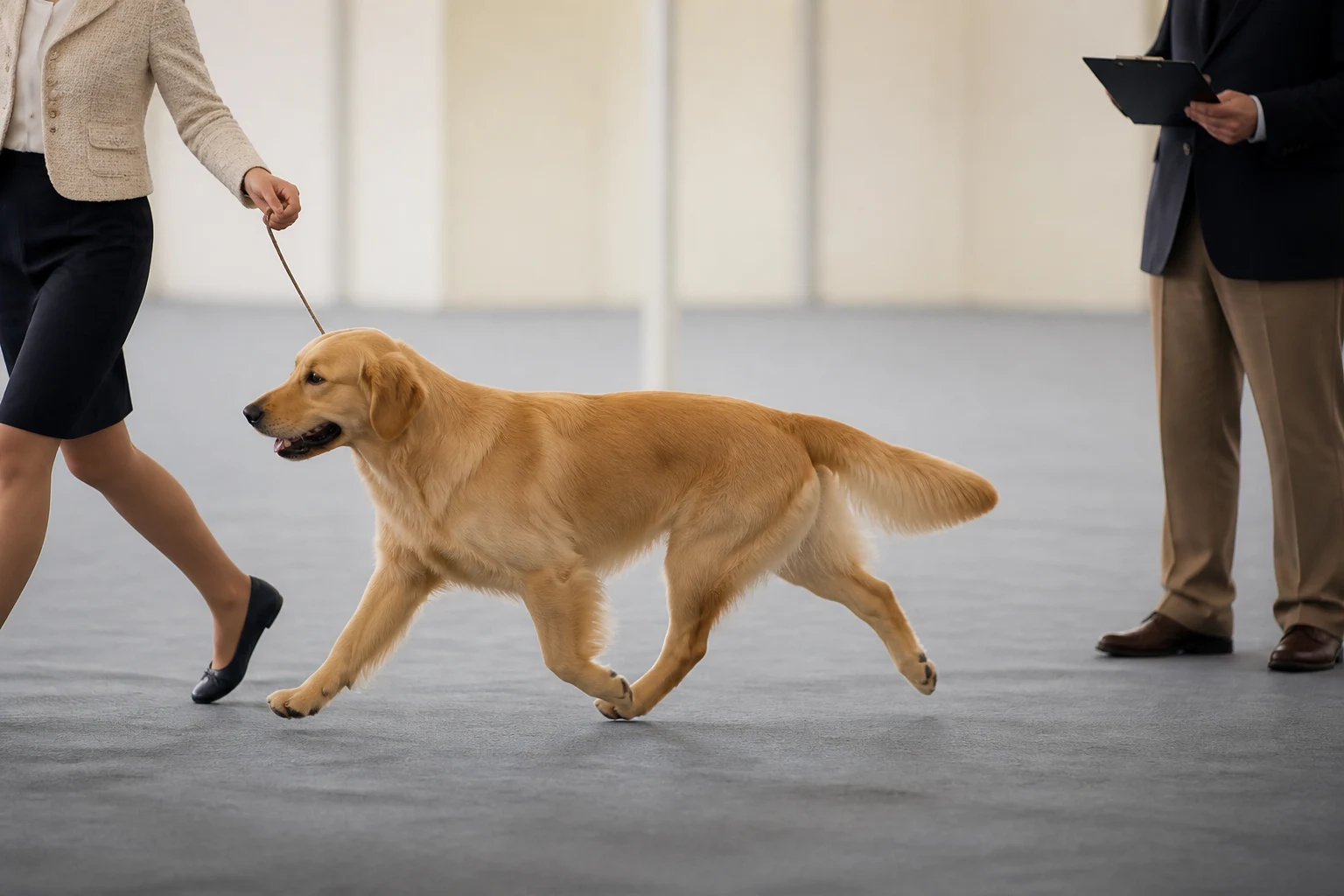
Golden Retriever moving at a controlled trot while a judge observes from a respectful distance
Illustrative image: conformation judging compares the dog seen on the day with a written breed standard.

Inside the ring

From first impression to hands-on examination

The Dogs Australia introduction to conformation describes a nose-to-tail examination followed by individual movement. As the class enters, a judge also sees outline, proportions, balance, condition and how each dog uses the ring. That first impression remains provisional until examination and movement.

The current national Conformation Show Regulations, Part 5 require an all-breeds judge to check dentition, overall conformation, entirety for males and movement. Goldens are examined on the ground under the applicable procedure. The physical examination allows the judge to confirm features that coat, stance or angle can obscure: skeletal landmarks, body substance, ribbing, forequarters and hindquarters, topline, tail set, coat texture and general condition.

Touch should be purposeful and humane. The judge is evaluating conformation, not performing a veterinary examination. Current procedure allows an exhibitor to request permission to check their own dog’s dentition, and it allows a judge to ask the exhibitor to show it. A calm presentation helps the judge see what is there; it must never be used to conceal structure, colour, coat or condition.
Structure in motion

Movement tests how the parts work together

The Golden standard calls for powerful movement with good drive, straight and true action in front and behind, and a long, free stride without hackney action. A judge therefore needs more than a side view. Moving away can reveal how the hindquarters track and stabilise; returning gives a view of the forequarters; the side gait shows reach, drive, topline and overall efficiency. The requested pattern and pace should make those observations possible within the available ring.

More speed does not necessarily produce better movement. A dog rushed beyond a natural trot may flatten its outline or lose coordination. A tight lead, slippery surface, restricted ring or distraction can also affect the picture. The judge assesses what is presented; one circuit remains a sample, not a laboratory measurement.

Movement also links form to the breed’s working heritage. It does not prove field ability or endurance, and a graceful circuit does not rule out orthopaedic disease. It shows how the dog moved in that setting at that time. Owners who notice new lameness, stiffness, reluctance or an altered gait should pause competition and seek veterinary advice rather than treating a show opinion as medical clearance.

Behaviour in context

The judge observes ring temperament, not the whole dog

The standard’s “kindly, friendly and confident” language expresses the breed ideal. In the ring, the judge can observe whether the dog can move near others, stand for examination and recover from ordinary show stimuli. The national Judges’ Code of Practice also addresses dogs that cannot be handled or that are regarded as savage or vicious under the relevant member-body rules.

Those procedural observations do not establish a behavioural diagnosis. A normally social dog may be unsettled by heat, noise, pain, crowding or a novel examination; a composed performance does not prove how that dog behaves at home, with children or around resources. The RSPCA guidance on canine communication is a useful reminder to notice the whole body and context. Persistent distress, an abrupt behavioural change or safety concern warrants a veterinarian and, where appropriate, a suitably qualified behaviour professional.

Presentation with integrity

What good ring preparation supports

Preparation should let the judge assess the dog fairly while protecting comfort and welfare.

Condition and coat

A clean, appropriately groomed coat and sound body condition make the outline and texture easier to assess. National rules prohibit substances or preparations remaining on a dog where they deceive, or are likely to deceive, the judge.

Calm handling

Practise standing, brief respectful touch, showing teeth and moving on a loose enough lead for a natural gait. Training should build predictability and confidence, not compel stillness through fear or discomfort.

Heat and surfaces

Australian conditions can change quickly. The current Dogs NSW show regulations illustrate how state rules add welfare duties around shade, water and adverse conditions. Check the rules for the host body and prioritise the dog over an entry fee.

An honest picture

Skilled presentation can organise a dog without altering the dog. It should not disguise a structural feature, manufacture coat or colour, force an unnatural head carriage, or keep an uncomfortable dog in competition.

Rules and consequences

Fault, withholding and disqualification are different ideas

A breed-standard fault is a departure from the described ideal, weighed according to seriousness. A judge may decide that no exhibit merits first place; under current national rules, if first is not awarded, later placings are withheld. Challenge and other qualifying awards are also discretionary. These outcomes say that the judge did not make that award under those conditions—not that the dog has no value or cannot be a rewarding companion.

Eligibility and conduct are separate from conformation merit. The standard notes that males should have two apparently normal testicles fully descended, while registration and show regulations define consequences around entirety. The rules also address incorrect entry, handling, dog or exhibitor conduct, and deceptive preparation. Each consequence must be read from the current rule rather than inferred from ordinary language.

One especially easy mistake is treating every “disqualifying” phrase in a breed standard as an automatic ban from an Australian exhibition. Part 5 states that breed-standard disqualifying faults are not ordinarily recognised as disqualification from exhibition, though they may be serious conformation faults; CACIB shows are an express exception. Use the current Dogs Australia regulations index and the host body’s schedule, because amended or international events may operate differently.

Evidence with boundaries

A show result is not a health or breeding certificate

At a routine all-breeds event, the result usually records class placings and awards; national procedure does not require an individual written critique or grading. Specialist and CACIB formats can differ. Even a detailed critique remains one judge’s account of the exhibit presented on the day. It can describe strengths and limitations, but it cannot certify genetic health, long-term soundness, reproductive quality or future offspring.

Health evidence lives in other systems. Dogs Australia’s CHEDS scheme records hip and elbow radiographic assessments, while ORCHID’s Australian Canine Eye Scheme records specialist eye examinations. Cardiac assessment and relevant DNA results also require their own documents and interpretation. Screening can reduce uncertainty; it does not make a guarantee, and a ribbon cannot substitute for it.

A responsible breeding decision joins several kinds of evidence: verified individual results, health information from close relatives, pedigree and diversity analysis, behaviour observed over time, functional soundness, age, welfare and an honest purpose for the pairing. A title may show repeated success under applicable award rules. It cannot answer those other questions by itself.

Training and accountability

What a judge is qualified to decide

Conformation judges progress through member-body education and assessment within the national framework. The Dogs Victoria training outline includes anatomy, rules, ethics, construction for function, gait, breed standards, critiquing and practical ringcraft. The current Dogs NSW Conformation Judges Education Program likewise uses theory and practical examinations, including placing dogs in order. These state pathways operate under Dogs Australia’s national regulations.

Qualification authorises a judge to make show decisions for approved breeds or groups under the rules. It does not make every decision beyond debate, nor turn a judge into a veterinarian, geneticist or behaviour clinician. Good judging requires consistent procedure, equal opportunity, breed knowledge, decisive comparison and respectful handling. Exhibitors remain responsible for their dog’s welfare and for following the steward’s directions and event rules.

Reading the record

Put every result back into context

Record the event date, organising body, show type, judge, class, number actually presented and precise award. “Best of Breed”, a class first, a Challenge Certificate and a championship title are not interchangeable. Note whether a critique or grading was part of that format. If an award was withheld or a dog was excused, seek the applicable wording rather than inventing a cause from an abbreviated result.

Patterns across different judges and conditions can be informative, especially when written critiques identify similar features. Still, repeated success reflects the population entered, rules and preferences as well as the dog. Photographs add limited evidence because stance, lens, timing, grooming and editing affect appearance. Use results to ask better questions about structure and movement, then keep health records, everyday behaviour and welfare in their proper, separate roles.

Frequently asked questions

Six limits worth remembering

Does a show win prove that a Golden Retriever meets every point of the standard?

No. A placing is the judge's comparative decision among eligible dogs presented in that class on that day. Faults are weighed in relation to degree and their effect on health, welfare and function. A win is not a statement that the dog is fault-free or ideal in every detail.

Are Golden Retrievers formally measured in the show ring?

The Australian standard states height ranges, but that does not mean every Golden Retriever is routinely measured at every show. The national all-breeds judging procedure identifies dentition, overall conformation, entirety in males and movement as checks. Any measurement must follow the current rules and event procedure, not an exhibitor's assumption.

Who checks a Golden Retriever's teeth?

Current Dogs Australia all-breeds procedure includes checking dentition. It also allows an exhibitor to request permission to check their own dog's dentition, or a judge to ask the exhibitor to show it. The judge remains responsible for applying the procedure and the dog should be handled calmly and humanely.

Can a conformation judge diagnose health or temperament?

No. A judge can observe structure, movement, condition and behaviour during a brief ring examination and apply the show rules. That snapshot is neither a veterinary examination nor a behavioural assessment across contexts. Pain, unusual stress or a persistent behaviour concern belongs with a veterinarian or appropriately qualified behaviour professional.

Does the word disqualified mean the same thing as a breed-standard fault?

No. Dogs Australia rules state that faults described as disqualifying in a breed standard are not ordinarily recognised as disqualification from exhibition, although they may be treated as serious conformation faults. CACIB shows have a specific exception. Eligibility, conduct and procedural rules can create separate consequences, so read the rule that applies to the event.

Does a championship title prove that a Golden Retriever should be bred from?

No. A conformation title records qualifying show awards under the applicable rules. Breeding decisions also require independently verified health screening, veterinary context, knowledge of close relatives, stable behaviour across ordinary life, pedigree analysis, welfare planning and an honest reason for the proposed pairing. No title guarantees health or offspring quality.