Sniff and explore
Walks that allow safe scent investigation offer information and choice. Vary route, surface and pace to the dog’s confidence, fitness and weather rather than chasing a universal distance.
Development · care · decisions
A practical guide to adolescence, health and handling that uses sex-specific context where it matters—and treats temperament, learning and compatibility as individual.
Descriptions such as “males are more affectionate”, “slower to mature” or “always easier” sound useful because they are simple. They are not reliable predictions for one Golden Retriever. Inherited traits beyond sex, prenatal and early experience, socialisation, health, reinforcement history and the current environment all contribute to behaviour. Meet the dog, observe recovery after novelty and ask what support that individual needs.
The Dogs Australia Golden Retriever standard describes the same kindly, friendly and confident temperament ideal for the breed, while listing different ideal height ranges for dogs and bitches. A standard is not a promise: males vary in size, coat, activity, confidence and sociability, and a feature outside the ideal does not explain the whole dog.
Practical planning should therefore use measured adult dimensions, body condition and observed behaviour rather than a sex label. Check that transport, sleeping space and handling arrangements suit the actual dog. Consider strength on lead, but teach lead skills instead of assuming a larger body must be controlled by force.
A changing learner
Physical growth, reproductive development and social maturity do not finish together. The AAHA canine life-stage guidelines use broad, breed- and size-aware stages because preventive care should follow the individual. A dog who looks adult may still need simplified training, generous rest and careful exposure; an age label cannot tell you when joints, behaviour or coping skills are “finished”.
Expect learning to remain sensitive to context. A familiar recall in the garden may not transfer to wildlife, other dogs or a new field. Rebuild behaviours at an easier distance, reward check-ins and use a long line where lawful and safe. Avoid testing recall beside roads or relying on reproductive status as a safety system. Secure fencing and attentive supervision matter for intact and desexed dogs alike.
The AVSAB humane training statement recommends reward-based methods and rejects aversive tools. The RSPCA reward-based training guide similarly focuses on setting the dog up to succeed. Break skills into achievable steps: settling while visitors arrive, walking past distraction, exchanging an item, waiting at a gate, accepting grooming and returning when called.
Daily outlets
More intensity is not automatically better for an adolescent or adult male.
Walks that allow safe scent investigation offer information and choice. Vary route, surface and pace to the dog’s confidence, fitness and weather rather than chasing a universal distance.
Use short, controlled retrieves on suitable footing, with pauses and an easy release. Repetitive sharp turns, slippery launches or exercise through lameness are poor substitutes for gradual conditioning.
Brief sessions can practise recall, loose-lead walking, stationing, handling and calm observation. Reinforce what you want instead of waiting for arousal to peak and then punishing it.
Provide a quiet, comfortable place where the dog will not be disturbed. Review the day if activity produces irritability, reluctance, stiffness or difficulty settling, and seek veterinary advice for physical change.
The RSPCA enrichment guide includes cognitive, environmental, feeding, scent and social options, while warning that poorly chosen objects or over-reliance on food can create risks. Rotate safe activities and supervise anything that could splinter, entangle or be swallowed.
Behaviour before labels
Urine marking and mounting are not exclusive to males and do not establish “dominance”. Context can include learning, scent, arousal, stress, play or a medical problem. Note when the behaviour occurs, what happened immediately before it and whether the pattern changed suddenly. Reinforce an alternative, manage access and clean marked areas appropriately; avoid confrontation or physical correction.
A sudden increase in urination, straining, pain, blood, discharge or persistent genital licking needs veterinary assessment. If a health cause is excluded, a qualified reward-based professional can help analyse triggers and teach an alternative plan. Desexing may alter some hormonally influenced behaviour but cannot erase learning or resolve fear, pain and conflict.
Dog-to-dog compatibility is also individual. Do not assume that all males will compete, or that any male is safe with every dog. Introduce on neutral space with room to disengage, monitor loose versus tense body language and avoid forcing greetings. The RSPCA canine communication guide explains why the whole body and situation matter more than one tail or posture.
Cooperative care
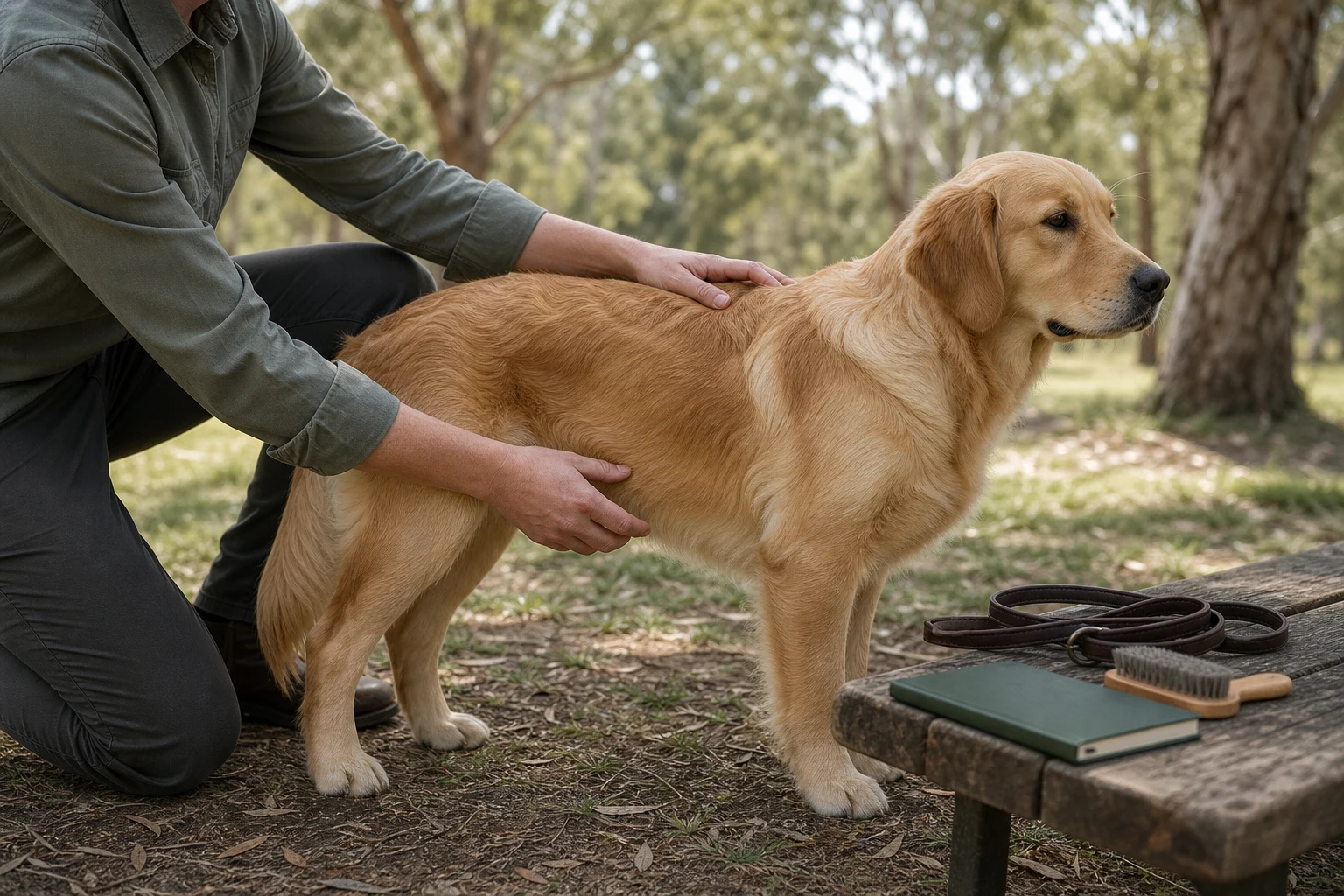
Practise consent-based steps when the dog is comfortable: a chin rest, brief touch to shoulder or flank, lifting an ear flap, holding a paw, brushing one area and standing quietly on a non-slip surface. Reward after each small step and stop if the dog stiffens, turns away, repeatedly licks the lips, struggles or tries to leave. Those signals are information, not disobedience.
Owners do not need to perform a veterinary genital examination. Teach calm positioning so the veterinarian can check reproductive anatomy, and report changes you see without squeezing a lump or trying to move a testicle. The standard expects two apparently normal testicles fully descended into the scrotum, but only a veterinarian can assess an individual finding and advise on health management.
Extend the same method to the dense coat: brush in sections to the skin without pulling, check for moisture or debris around ears and feet, and introduce bathing, drying and nail care gradually. New pain, skin change, odour, ear discomfort or handling sensitivity belongs in a veterinary conversation rather than a harder grooming session.
Veterinary decisions
The Australian Veterinary Association policy recommends that procedure and age be decided case by case with the client, weighing risks, benefits and current evidence for the individual animal. The RSPCA Australia desexing guide likewise notes that timing and approach depend on the animal, circumstances and local legal requirements.
Discuss projected adult size, growth, health history, ability to prevent mating, household context and relevant state or council duties with the veterinarian. Ask what benefit is expected, what trade-offs matter, which alternatives are available and how weight and activity will be monitored afterwards. Do not copy a date from another dog or delay essential management while waiting for a preferred milestone.
The WSAVA reproduction-control guidelines also frame gonadectomy decisions individually. Surgery should not be sold as a guaranteed cure for mounting, marking, roaming or aggression. Behaviour with a sudden onset, safety risk or suspected pain needs veterinary evaluation, with a suitably qualified behaviour professional involved where appropriate.
Prevention and observation
Preventive care should include body and muscle condition, oral health, parasite and vaccination planning, skin and ears, mobility, behaviour and reproductive status according to life stage and local risk. The WSAVA nutrition resources support individual nutritional assessment rather than choosing food or portions from sex alone. Ask the veterinary team to set an appropriate body-condition target and review it through growth, desexing and changing activity.
Book a consultation for a new lump or asymmetry, discharge, persistent licking, altered urine stream, increased frequency, blood in urine, recurrent stiffness, new exercise reluctance or a clear behaviour change. These signs have several possible causes; an online description cannot diagnose them. Record onset, frequency and a short video when safe, but do not delay care to collect perfect evidence.
Inability to pass urine or repeated unproductive straining is urgent: the MSD Veterinary Manual’s owner guidance identifies complete urethral blockage as an emergency. Major trauma, severe or rapidly increasing pain or swelling, collapse, breathing difficulty and ongoing seizures also require urgent contact. In Australian heat, heavy persistent panting with weakness, confusion, vomiting, tremors or collapse may indicate heatstroke; the RSPCA heatstroke guide advises immediate veterinary attention.
Reproduction is not an entitlement
Being male, entire, registered, titled or much loved does not establish reproductive suitability. Start with a documented purpose and consider welfare for the proposed sire, dam and resulting puppies. Stable behaviour across ordinary settings, physical soundness, family health, pedigree and diversity, reproductive health and the strengths and limitations of the proposed pairing all matter.
Australian Golden Retriever guidance commonly expects independently verifiable hip, elbow, eye and cardiac records. The Dogs Australia CHEDS scheme covers hip and elbow assessment, and ORCHID’s Australian Canine Eye Scheme records specialist eye examinations. The Golden Retriever Club of NSW buyer guidance asks for hip, elbow, heart and eye certificates for both parents and warns that DNA testing does not replace those records.
Match every certificate to registered identity, microchip where recorded, test date, issuing body and result. Relevant DNA findings must be interpreted in the pairing rather than reduced to “clear” marketing. Screening changes information about risk; it cannot guarantee health or temperament. Consult the breed club, veterinarian and relevant specialists for current protocols, and a reproduction veterinarian before any mating or semen collection decision.
Frequently asked questions
Sex does not reliably predict an individual dog's affection, confidence, sociability or trainability. Genetics beyond sex, early experience, health, reinforcement history, environment and the current situation all matter. Choose and teach the individual in front of you rather than expecting a male stereotype.
There is no single finish date. Physical growth, reproductive development and social maturity are related but separate processes, and breed, body size, health and experience affect their timing. Use behaviour and veterinary assessment rather than a birthday to decide when to change exercise, feeding, management or reproductive plans.
It is not a guaranteed behaviour treatment. Hormones may influence some behaviour, but marking, mounting or aggressive responses can also involve learning, stress, arousal, fear, pain or another medical issue. Discuss health, reproduction and timing with a veterinarian, and use humane behaviour assessment and training for the behaviour itself.
Australian breed guidance emphasises independently verifiable hip, elbow, specialist eye and cardiac results, with relevant DNA results interpreted for the proposed pairing. Match every result to the registered identity and date, review health in close relatives and ask veterinary or genetics professionals about uncertainties. Screening reduces risk; it cannot guarantee offspring health.
Arrange a veterinary examination rather than trying to locate or manipulate it yourself. The veterinarian can assess the individual, explain health implications and discuss an appropriate management or surgical plan. Do not use the dog for breeding while the finding is unresolved; the Dogs Australia breed standard expects two apparently normal testicles fully descended.
Inability to pass urine, repeated unproductive straining, severe or rapidly increasing genital or abdominal pain or swelling, major trauma, collapse, breathing difficulty, ongoing seizures and suspected heatstroke require urgent veterinary contact. Blood in urine, a new lump, discharge, persistent licking or a clear change in urination also warrants prompt veterinary assessment.
Continue in context
Use the route that matches the decision you are making now.
Daily life, temperament variation, grooming and health.
02Verify sources, parent records and identification.
03Individual care with female reproductive context.
04Understand what a ring result can and cannot establish.
05Separate awards from health and breeding evidence.
06Question conclusions drawn from one photograph.